How to implement ARP Spoofing in NetSim?
Introduction
ARP (Address Resolution Protocol) spoofing, also known as ARP poisoning, is a cyberattack where an attacker sends falsified ARP messages over a local network. This malicious activity associates the attacker’s MAC address with the IP address of a legitimate device, redirecting traffic intended for the victim to the attacker instead.
This article demonstrates how ARP spoofing can be implemented in NetSim, a network simulation tool, by modifying ARP protocol behavior and analyzing the attack’s impact.
How ARP Spoofing Works?
- Normal ARP Behaviour: Devices on a LAN use ARP to map IP addresses to MAC addresses.
- Spoofing: The attacker sends forged ARP replies to the victim/gateway, associating the attacker’s MAC with the IP of the gateway or target.
Example Network Scenario:
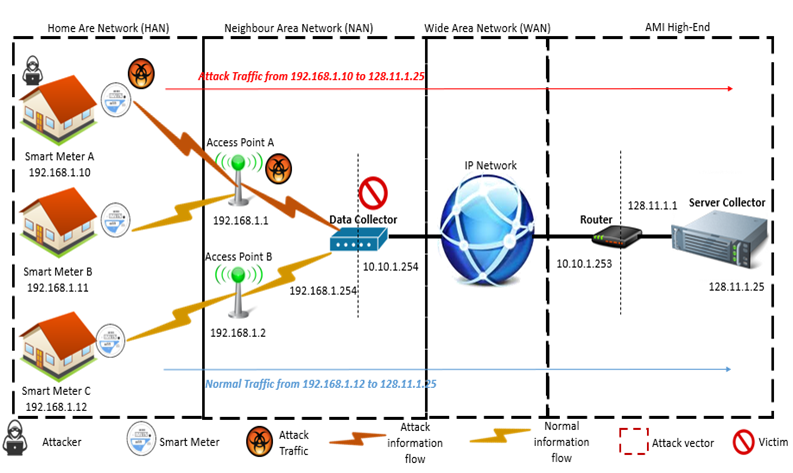
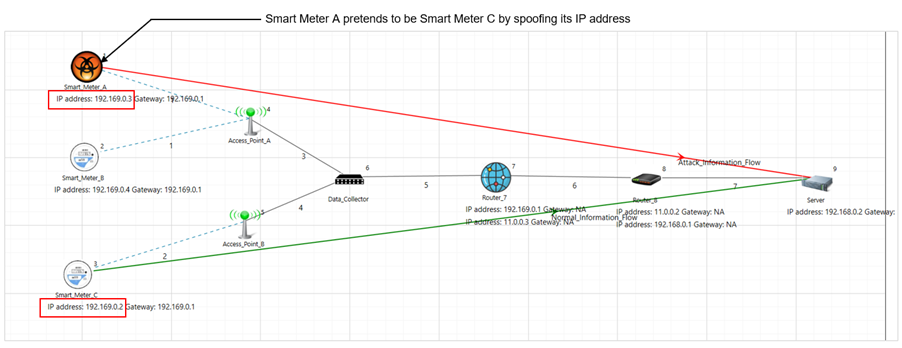
- Attacker Node: Smart Meter A (192.168.1.10)
- Victim Node: Smart Meter C (192.168.1.12)
- Target Server: Server Collector (128.11.1.25)
Smart Meter A poisons the Data Collector’s ARP cache, making it believe Smart Meter A’s MAC address corresponds to Smart Meter C’s IP. This allows Smart Meter A to send falsified data to the Server Collector while impersonating Smart Meter C.
Network Setup in NetSim
Software: NetSim Standard v14.3, Visual Studio 2022
Project Download Link:
https://github.com/NetSim-TETCOS/ARP-Spoofing-v14.3/archive/refs/heads/main.zip
Follow the instructions specified in the following link to download and set up the Project in NetSim:
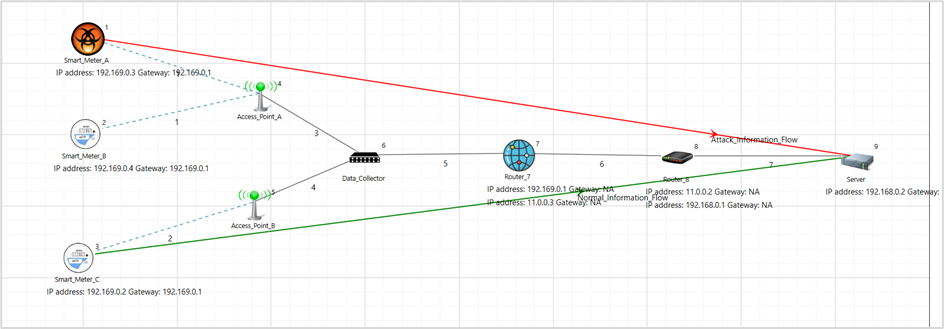
The simulation involves:
Home Area Network (HAN): Smart Meters (A, B, C)
Neighbor Area Network (NAN): Access Points
Wide Area Network (WAN): Data Collector & Server
Key Devices:
| Device | IP Address | Role |
|---|---|---|
| Smart Meter A | 192.169.0.3 | Attacker |
| Smart Meter C | 192.169.0.2 | Victim |
| Server Collector | 192.168.0.2 | Target Destination |
Source Code Modifications
To simulate ARP spoofing, the following changes were made in NetSim’s source code:
ARP Protocol Modifications
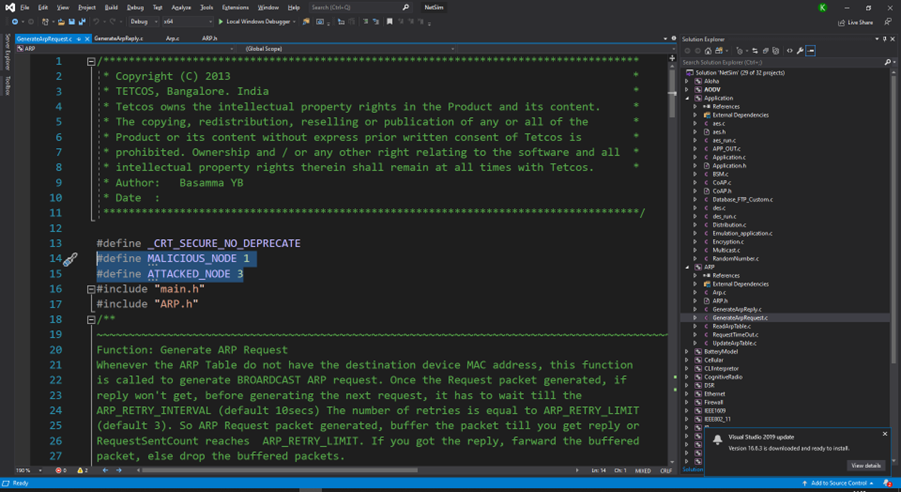
- GenerateArpRequest.c
- Defined attacker (Smart Meter A) and victim (Smart Meter C) nodes.
- Modified fn_NetSim_Generate_ARP_Request() to include a false IP address in ARP packets.
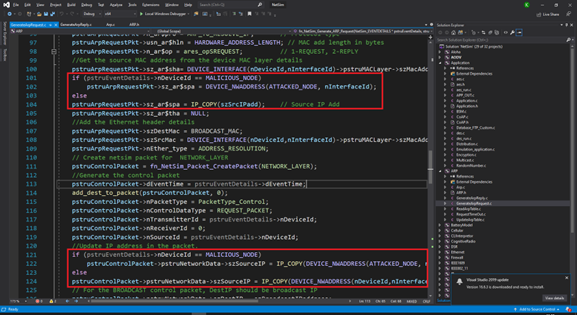
- Defined attacker (Smart Meter A) and victim (Smart Meter C) nodes.
- ARP.c
- Added fn_NetSim_ARP_Table_Update_Log() to log ARP table changes for analysis
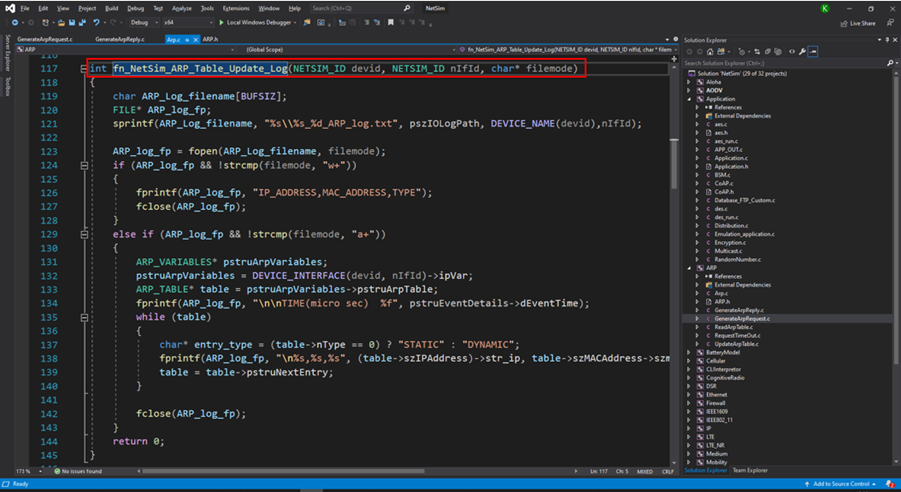
- Added fn_NetSim_ARP_Table_Update_Log() to log ARP table changes for analysis
3. Application Project Modifications
- In Application.h, attacker and victim nodes were defined.
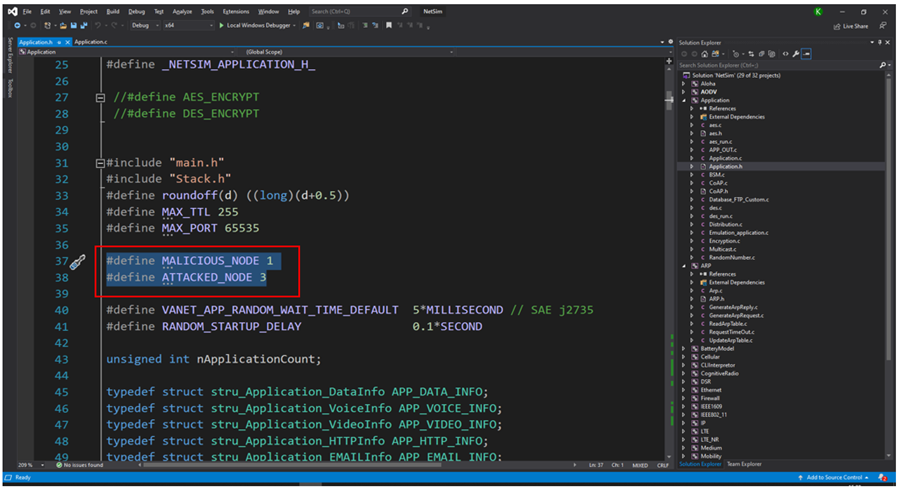
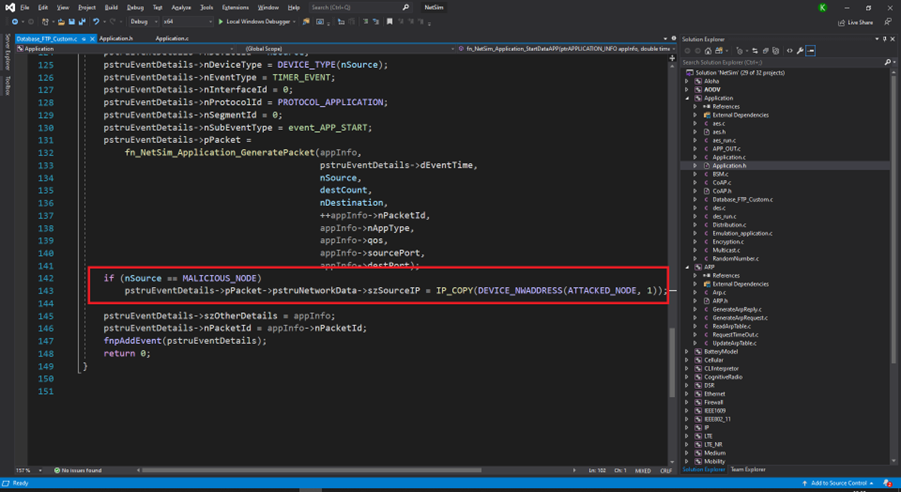
- In Database_FTP_Custom.c, the function fn_NetSim_Application_StartDataAPP() was altered to spoof the source IP in data packets.
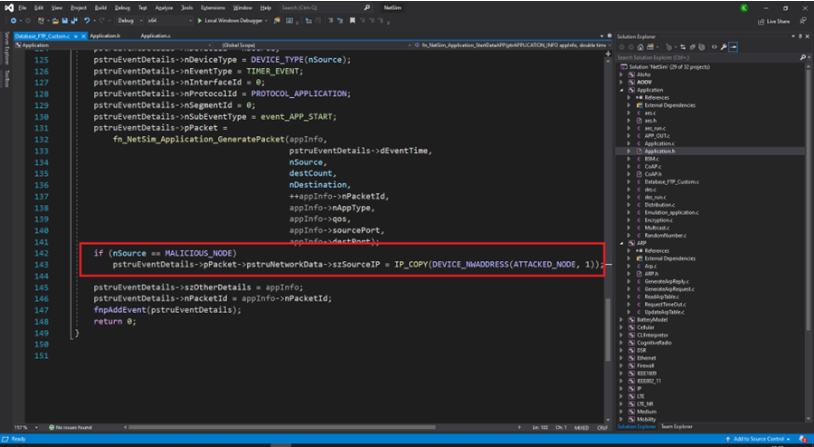
- In Application.c, fn_NetSim_Application_GenerateNextPacket() was updated to maintain the spoofed IP in subsequent packets.
Simulation Configuration
- Enable packet trace prior to the simulation, by clicking on configure reports on top ribbon and disable the static ARP table by clicking on Options > Static ARP > Disable.
- Run the simulation for 10 seconds.
Results and Analysis
The screenshot below displays the NetSim packet trace with packets filtered to show Smart Meter A (the attacker node) as the transmitter. Both the ARP request and the data packets sent from the attacker node have a spoofed source IP address (192.169.0.2) instead of its actual IP address (192.169.0.3).
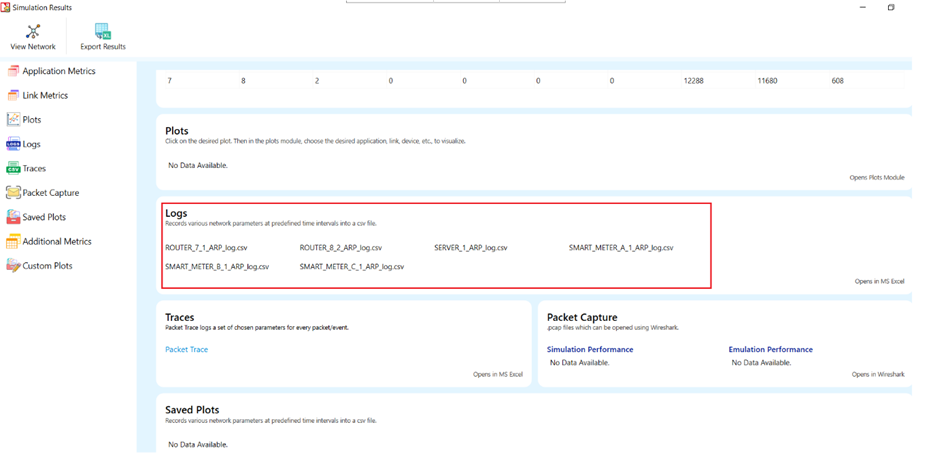
ARP Logs
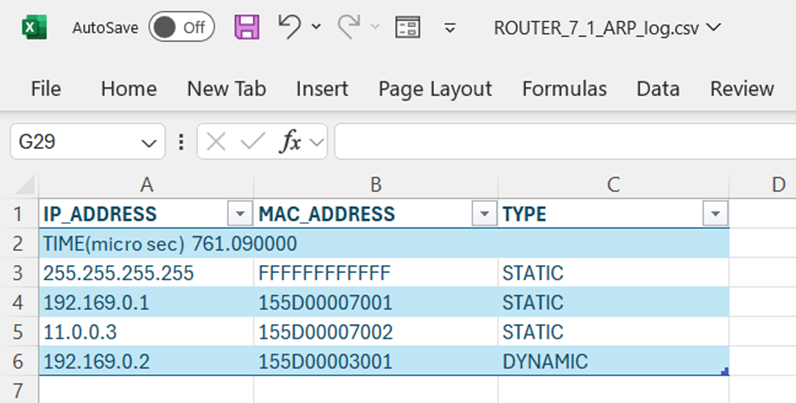
The logs (ARP_log.csv) show manipulated ARP table entries:
| IP Address | MAC Address | Type |
|---|---|---|
| 192.169.0.2 | Victim node (Smart Meter C) | DYNAMIC |
Conclusion
This article demonstrated how ARP spoofing can be simulated in NetSim by modifying ARP behavior and analyzing the attack’s impact.